Friday, 21 November 2014

Punishment

Hye, everyone... Im back again!!! hope u are doing good...

well, as i promised u in my previous post on reinforcement, im going to write about punishments in this new post. hope u'll enjoy reading it.

first of all, let's see what is punishment. punishment is defined as the consequence that occurs immediately after an operant behavior, that reduces the occurrence of the same behavior in the future. basically, punishment attempts to decrease the likelihood of an unpleasant behavior from occurring again in the future.

there are two types of punishment which are positive punishment and negative punishment. both positive and negative punishment are defined as follow:
positive punishment - the occurrence of an unpleasant behavior is followed by an immediate consequence of adding or increasing the intensity of an aversive stimulus, to reduce the occurrence of the behavior in the future.

negative punishment - the occurrence of an unpleasant behavior is followed by an immediate consequence of removing or decreasing the intensity of an pleasant stimulus, to reduce the occurrence of the behavior in the future,

therefore, both positive and negative punishments attempts to reduce the occurrence of the behavior in the future but works in a different way. the examples provided below will help u to differentiate both of the stimulus.

examples :

positive punishment :

John fights with his brother and hits him. therefore, the mother punishes him for hitting his brother by grounding him in his room. hence the unpleasant target behavior (John hitting his brother), is immediately followed by introducing an aversive stimulus as its consequence (the mother grounded him). since, John would hate to be grounded, he would not repeat his behavior in the future because he learned that if he hit his brother, he will be grounded by his mother. this, results in the decrease of the behavior in the future.

negative punishment - 

John fights with his brother and hits him. therefore, the mother punishes him for hitting his brother by not allowing him to watch television. hence, the unpleasant target behavior (John hitting his brother) is followed by removing the pleasant stimulus as its consequence (the mother doesn't allow him to watch television). since, John love to watch television, and he would hate it if someone doesn't allow him to do so, he would not repeat his behavior in the future. this is because, he learned that if he hit his brother, his mother won't let him to watch television. this, results in the decrease of the behavior in the future.

based on the examples provided, i would like to conclude that positive punishment involves presenting an unpleasant stimulus as the consequence of a behavior whereas negative punishment involves the removal of a pleasant stimulus as the consequence of a behavior. 

for further information regarding punishment and the differences between punishment and reinforcement, u can refer to the links below:


here's a video that can help u to know more on punishment..enjoy watching..


so, thats all from me for now..till we meet again in my next post..see yah..take care.. :D

Sunday, 16 November 2014

REINFORCEMENT

hye everyone...how are you all doing?? hope you are still in a good shape..


well, today i intend to write about reinforcements...u might be wondering what is that all about and how does it be helpful..actually,reinforcement are one of the ways used to modify a target behavior. wait, what is target behavior now?? target behavior is the a undesirable or desirable behavior that you intend to increase or decrease in terms of its frequency, intensity, duration or latency. basically, a target behavior is the behavior that you intend to change or acquire. for instance, you might have nail biting behavior and you plan to get rid of it. so, that nail biting behavior is now referred to as the target behavior.


so how does these reinforcement work in  modifying the target behavior?? before that,  let's have a look at what is reinforcement.

 reinforcement is defined as, the occurrence of a particular behavior is followed by an immediate consequence that results in the strengthening of the behavior.  the consequence that strengthens the behavior is called a reinforcer. there are two types of reinforcement which are:

1) positive reinforcement - the occurrence of a behavior is followed by the addition of a stimulus (reinforcer) or an increase in the intensity of the stimulus which results in the strengthening of the behavior.


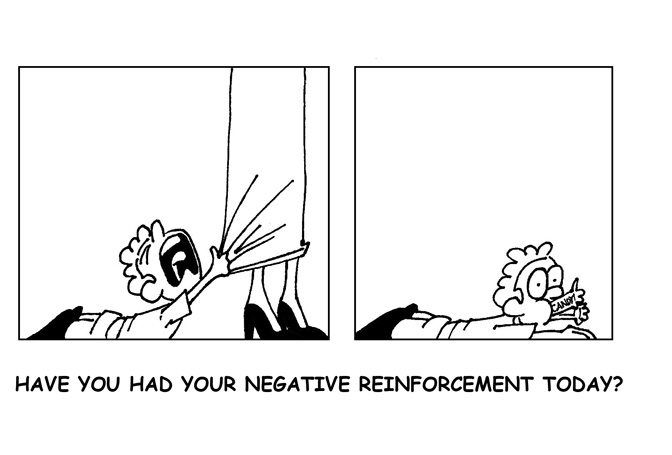
2) negative reinforcement - the occurrence of a behavior is followed by the removal of an aversive stimulus or a decrease in the intensity of a stimulus which results in the strengthening of the behavior.

both positive and negative reinforcement strengthens the target behavior and results in increased occurrence of the behavior in future. the difference between positive and negative reinforcement is in the term of whether the stimulus is added or removed. in positive reinforcement, everytime a desirable behavior occured, the person is rewarded with something pleasant immediately thus increasing the likelihood of the behavior reoccuring in the future. however, in negative reinforcement, every time a desirable behavior oocured, the person is rewarded by removing an aversive or unpleasant stimulus, thus increasing the likelihood of the reoccurrence of the behavior.

example:
1) positive reinforcement

- A child managed to clean his room on his own. following that, the mother allows him to play his favourite computer game. in this case, the target behavior is cleaning the room on his own and the positive reinforcer is being able to play computer game. hence, here a pleasant stimulus (computer game) is introduced immediately following the behavior (cleaning the room). therefore this increases the likelihood of the child cleaning his room on his own in the future, because he knows that if he do that, he will be allowed to play computer games.


2) negative reinforcement

- a child managed to clean his room. following that, his mom stops nagging him. in this case, it is almost similar to the above situation but there is slight difference in the way the reinforcer is administered. in this situation, the target behavior is cleaning the room on own and the negative reinforcer is mom stops nagging. hence, here an adversive stimulus also known as unpleasant stimulus  (mom nagging) is removed immediately following the behavior ( cleaning the room). therefore this increases the likelihood of the child cleaning his room in the future, because he knows that by doing so he can make sure his mom stops nagging.


basically both these positive and negative reinforcement works to increase the occurrence of a desirable target behavior in the future. u might be wondering how to decrease the occurrence of an undesirable target behavior in the future.. that one i'll explain in my next post. so, till then see yah

Thursday, 6 November 2014

Conformity.... :D

Hye everyone...what's up..hope everything is going good.. Well, I'm glad to be writing again..Today i'm going to write about an interesting topic that I had read in my Social Psychology book last semester. It's about conformity. Actually, last semester my lecturer had assigned us with a group project where we need to come out with a video that shows an experiment on any of the topic that we have read in our Social Psychology experiment. I and my group members had several topics on mind but we finally decided to choose conformity because it is a quite interesting topic and we were sure the experiment could turn out well. so, here we go..allow me to share what is conformity is all about and what kind of experiment that we did to test out this conformity thing.


First of all, let us see what does conformity means. Conformity refers to any change in behavior caused by another person or group; the individual acted in some way because of influence from others. It also refers to the act of matching attitudes, beliefs, and behaviors to group norms. hence, it is a type of social influence that results in the change of behavior or belief in order to fit in a group. conformity often occurs due to real or imagined group pressures. (McLeod, S. A. (2007). What is Conformity? Retrieved from http://www.simplypsychology.org/conformity.html). 


There are several popular experiments that have been conducted back at those times to test conformity. one of the most popular experiment conducted was the Asch Conformity Experiment. 


during the 1950's, a psychologist Solomon Asch conducted a series of lab experiment to test out conformity. in the experiment, participants were told that they would be participating in a 'vision test' and brought into a room with several other people, however, the participant didn't know that the rest of participants except for him are confederates. during the experiment the participants are presented with a set of lines and they have to match those lines with another set of lines that have the same length. each of them have to say out loud their answers. initially the participant and the confederates would be telling the correct answers. after some time the confederates would purposely give wrong answers to see whether the participants agrees with them or not. even though initially, the participant stays firm with his or her own answer, but eventually they tend to conform and follow what the others say and continues to answer wrongly too.this shows conformity had occured due to group pressure.  the video presented above shows the experiment that was conducted. to get further information on this topic you can try this links below: 


1) http://www.age-of-the-sage.org/psychology/social/asch_conformity.html 
2) http://psychminds.com/solomon-aschs-experiment-conformity/


so based on these ideas, our group decided to test it out on our university students. but we wanted to try it out differently and in a hilarious way. so what we did, we came with this 'invisible rope' experiment. in these experiment, two of our group members would be pretending to hold a rope across a narrow walkway (the rope doesn't exist..just a imaginary one). some of us would be acting as the confederates. whenever, we see people approaching the walkway, our confederates would walk through the way first and pretend to cross over the rope as if it exists. we would see if the people do the same or just ignores since they know the rope doesn't exist. the results was quite astounding. what we found out is that, when there is no confederates walking in front of them and when they don't see anyone crossing the rope, they tend to ignore and walk through it. but when people see others crossing the rope, they tend to do the same, even though they know there is no such rope that exist.


here is the video of our experiment. hope u enjoy. so that's all from me for now..see yah in my next post..stay happy always.. :D


Friday, 31 October 2014

Sleep.... Zzzzzzzz..

Hello everyone!!! glad to be writing again after sometime...Well..today i would like to talk about something that is very important in our life in order to function well...yup.. I'm gonna talk about 'SLEEP'...

Imagine lying on a cozy bed, covered up with your comfy blanket, cuddling your soft pillow and being able to sleep soundly as soon as your head touches your pillow...haaa...even the thought itself can make me yawn..getting a good night sleep is essential for us in order to function well. An uninterrupted sleep of approximately 7 to 8 hours per night is what all of us require. Why do we need to sleep?? Is sleep that important?? Well, it is important.. Most of us find sleeping as the best time to relax ourselves from a hectic day. In fact, some of us also find sleeping as one of the way to forget all our problems for some time. whatever the reason is, sleep is beneficial to our body and mind.
however, we are taking our sleep for granted..To deal with our everyday task, we tend to deprive ourselves from getting enough sleep. however, we do not realize that lack of sleep could actually affect our health, our ability to perform at work and the ability to concentrate in our daily tasks.
therefore, i would like to share some good tips on how to get a good sleep!!
#1 Keep A Regular Schedule For Sleeping

setting a sleep schedule makes your body to get adapted with a routine sleep and wake cycle. so try sleeping and waking up at the same time each day. this way you can even wake up without the need to set up an alarm since your body is used to the routine. besides that, you should also maintain this routine even on weekends. 

#2 Make Your Bed Sleep Friendly     

a comfortable environment is important to trigger a quality sleep. make sure your bed is comfortable enough because i'm sure you don't wanna end up waking up in the morning with a back pain or an aching neck. besides that, make sure your bedroom is noise-free. A silent environment is what you need to get a good sleep. however, sometimes a too silent environment would be creepy enough. therefore, have some soothing music in your room to mask off the too silent environment. other than that, a cool environment can also make you sleep better. keep your temperature slightly cold, because a too hot environment or too cold environment can interfere with your sleep.

#3 Exercise Regularly

a regular exercise routine can help you fall asleep easily and sleep more soundly. simple exercises are sufficient for your body to expand its energy. however avoid exercising late in the day because it can raise your body temperature and stimulate your body, this can make you stay awake at night. engaging in relaxing exercises such as yoga helps to promote sleep.

#4 Be Aware Of What You Eat

avoid eating large meals a few hours before your bedtime. this is because the digestion process can keep u awake.  besides that, avoid taking caffeinated drinks after lunch because caffeine can keep you awake for at least 10 to 12 hours after consuming it. other than that, also avoid taking alcohol before bed. even though a nightcap before sleep, can make you fall asleep faster but it can make you                                                           wake up in the middle of the night.

#5 Resolve Stressors

Stress is one of the main factor that causes most of us unable to sleep at night. learn to manage your thoughts and stop worrying. try to divert your mind from thinking about your problems or things that causes you to worry. instead, try on some relaxation techniques to calm yourself down such as deep breathing or visualizing a calm and restful place.

Basically, these are some of the tips that i got to know..hope its helpful enough for most of us..see yah in my next post soon. bye!!! :D sleep tight... :P


Friday, 17 October 2014

THE 'Good Presenter'... (Part 2) :

hellooo..everyone!!! well, sorry to keep you waiting for quite a long time for the part 2 of the 'Good Presenter'.. I had been quite busy with my loads of assignments and stuffs for these past few weeks..fuhhh..finally it's all over for now..so here i am again to share with u with more tips on how to become a good presenter....Here u go!!!!
Since I have shared three tips on my previous post on how to become a good presenter, now I'll continue with the fourth one. The fourth tip is to stay calm all the time. you have to make sure you are calm enough before, during and also after presentation. Don't stress yourself a lot because it can affect the way u do your presentation. When you are too stressed out or nervous, you will tend to stammer and you might forget your important points to be delivered. These can also make u go blank in the middle of your presentation. Imagine how embarrassing it would be if u suddenly go blank and have to stop your presentation abruptly!!! OMG,..that's too awful.. Therefore, you must try to conceal your nervousness and keep it in control. Of course, everyone do feel that little tingle of nervousness during giving a speech or doing a presentation. But for some they can easily get nervous to extreme levels. You should always bear in mind that no one can actually realize how u feel deep inside when you are doing a presentation. they wouldn't know whether you are nervous or not. you are emotions are not leaked out. It all depends on how you carry yourself in front of others. You should be able to tackle your feelings and put on a confident image in front of others. When you are able to do that, your audience wouldn't know that you are too nervous deep inside and these can make them to pay attention to what you are trying to say. There are few techniques that you can do to control your nervousness such as doing breathing in and out a few times and listening to calm musics before presentation, Once you are able to control your nervousness, trust me, you will rock your presentation!!! :)
                                               

Moving to the next tips, being presentable is one of the criteria of being a good presenter. Always bear in mind first impression is the best impression. therefore, make sure that you look presentable during your presentation. Wear nice formal outfit that you are comfortable with and which can make you look extra confident. Looking presentable doesn't mean you should overdo it, in sense of wearing thick make up and heavy accessories.Please avoid doing so!!!! Wear a simple and formal looking attire because that shows your level of professionalism. when you are looking presentable enough, your audience would be automatically attracted to you and they would start listening to your presentation. 
        

Last but not least, make sure you speak clearly. Don't mumble!!! Try to speak as loud as you can and make sure your speech is delivered as clear as possible. When you talk loudly, your 
voice have the power of captivating your audiences' attention. they would not fall asleep or get bored, because your voice is loud enough to keep them stay alert. besides that, intonation is also important during presentation. Don't ever read your text or slide!!! make sure there are some ups and downs in your voice intonation. that way your audience can understand more easily what you are trying to say and they won't get bored either. Remember your voice is the most powerful tool in delivering a presentation. no matter how prepared you are, but if you are not able to deliver your thoughts in a clear manner, then your presentation is considered a failure..
so, do some practices beforehand. Besides verbal language, non verbal language or a.k.a body language also plays an important part in being a good presenter. every time you are presenting in front, make sure you stand tall and straight with confidence. Don't Slouch!!! keep your hand movements in limit and don't  fiddle with your fingers because that shows you are nervous. But that doesn't mean you have to stand still as a statue. do move around but not frequently..keep it in a limit. To get your body language and verbal language right during your presentation, try practicing it out loud in front of the mirror. This way, you can correct your mistakes and make some improvements on it..


So, that's all from me..bear it in mind that anyone can actually turn out to be a good presenter. however, it all depends on how much effort do you take to be one. the more you practice, the more you will make improvements, and the more you will gain confidence out of it..so, good luck everyone..hope those tips i shared will be helpful for u... Come on.. u can do this!!! :D


Thursday, 2 October 2014

The "Good Presenter"...


(PART 1) :p


hello, everyone...well I'm back with a new topic today. How to be a good presenter? Well, I noticed that most of the students are actually having some difficulties in delivering a good presentation in the class. They appear to be too nervous and sometimes look unprepared. In fact, they even get too shocked when it's their turn for presentation. These affects their presentation style badly. A good presentation is necessary to deliver the right information to the crowd. Therefore students must master some of the presentation techniques so that they can improve their presentation skills and work on their presentation better. So today I would like to share some of the tips on how to be a good presenter and what you can do to tone down your nervousness. Okay, then let's get started!!!!


Firstly, make sure you are well versed with your topic. Once you decide on a topic to do a presentation on, make sure you do enough research on that particular topic. Do not assume or try to come with your own facts because you must make sure you deliver the right information to the crowd. There are possibilities that any of your audience who might know very well about that topic. So if you give out the wrong information, then the audience might lose their trust on you. So remember say only the right thing. If you are not sure about it, then don't talk about it. Therefore it is important for you to know your topic well. In fact, when you are well versed with your topic, you will feel more confident since all the information is on your fingertips. Try to think of the possible questions that your audience might ask you and prepare for it. This way you will feel you are well prepared.

Secondly, don't memorize your text. make sure you are organized enough by doing cue cards. jot down only important points to be mentioned on your cue card, Remember cue cards acts as cues to remind you of any important points in case you forgot. It is not a card for you to write down your whole text. If you do that, you have the chances to get stuck in the middle of your presentation. besides that, make sure you cue card is not too big to be noticed by others. it should be small enough that it can fit in your palm without being noticed by others. in fact, when you are holding a big piece of paper during a presentation, it not only hinders your movement but it also distracts you by tempting you to refer to it often. when this happens, you will appear to be unprepared and lacking of self-confidence.

Thirdly, know your audience well. before going for a presentation, make sure you know who are your target group. get to know them so that you can adapt easily during the presentation. make sure you make eye contact with your crowd. This way you can create a bonding with them. most of us don't do this. we tend to avoid eye contact with our audience since we feel it makes us moire nervous. but actually it is the only way to make you feel more comfortable.don't believe it??? then give it a try. 
making eye contact with your audience make you feel more closer to them. this can make you feel comfortable and confident since you know you audience well. in fact, this would make your audience to stay connected with you as well.


okay, so that's it for now. I'll continue with the next tips to be a good presenter soon!!! work on these three first!!! :D 

Wednesday, 24 September 2014

The SELFIE Craze...


(PART 2).. :D


Hellooooooo...well glad to be back again on this interesting topic...SELFIE!!!!! Alright..so yah as i had mentioned in my previous post, selfie could lead to narcissism. However, that is not the only bad effects of being constantly addicted to selfies. There are several other issues to be considered too. Okay, lets get down to this. In my personal opinion, there are both good and bad effects in constant selfie-ing.. Lets have a look at the negative effects first. Okay firstly I would say that constant selfie-ing consumes your precious time. It's true right!!! I mean I'm sure you would not be immediately satisfied with the single selfie that you took..I'm pretty sure you will be tempted to take selfies until you obtain your best shot. So that thought itself makes you to take tons and tons of selfies until you don't even realize how much time have passed..I remember reading this somewhere saying that "Behind every successful selfie, there are 99 failed and deleted shots" ..hahaha..it's kinda true right. Aiming for the perfect pose and shot, we sometimes get to involved in it that we even forget what's happening around us and how the time flies..Aside of wasting time on aiming for the perfect selfie, many also tend to waste time to edit the selfie to get an extra perfect look!!! And that takes like almost forever!!!Endless snap, edit..dissatisfied..delete..snap again...edit again...and this keeps on going on and on until finally we are really satisfied with it.. (which happens after a long period of time though :P)..


 Besides that, I would also say that constant selfie-ing affects your quality time spent with your family and friends as well. Let's say you are having a family gathering or a day out with your friends after a long time. Of course it is a great occasion and a part of memories in your life. You would be excited to store up those memories and cherish those moments spent together by taking selfies, so that you can walk down the memory lane in the future. But what really happens is that, you get too engrossed in it and start selfie-ing instead of spending your time with your family and friends.


 There is no use in storing up memories to be looked at in the future when you actually don't even enjoy yourself at that point of time. These behavior could also bring discomfort to your family and friends. They might have agreed to join you for a dinner or meet up with the idea of catching up with latest news, sharing some stories and have a good laugh at some jokes. However, your endless selfie-ing behavior probably will create a situation where there is less talk but more on hands on gadgets. I'm sure no one would like to have that kind of situation in a meet up. Then don't be surprised if next time you call your friend out, he or she turns down your offer!

Okay, now as for the positive side of selfie-ing...hmm..basically I think the good thing of selfie-ing is that you don't have the need to bother others to snap a picture of yours.


I mean yah who needs others help to snap your picture when you think you are looking on your best when you can do it on yourself. Anytime, anywhere..'click,click'..there we go,,the best shot of yours on your own.. :D


Other than, selfie-ing also boosts your self confidence..You tend to take the extra effort to be presentable each time when you take a selfie. So that definitely boosts your confidence level on your self image.

Lastly. I would say that selfie-ing is not a bad thing actually but it all depends on how regular are you doing it. There are limits for everything. Once you go beyond the limits, some good things can turn up to be too bad. The same goes with this selfie-ing thing. If you are still in your limits, then you are safe. But once you go off the limits, you will definitely pay the price for it. So, take selfies, enjoy yourself...but be in limits!!! I'm sure you can enjoy your life meaningfully then!!!!

That's all for now..see yah soon... :P